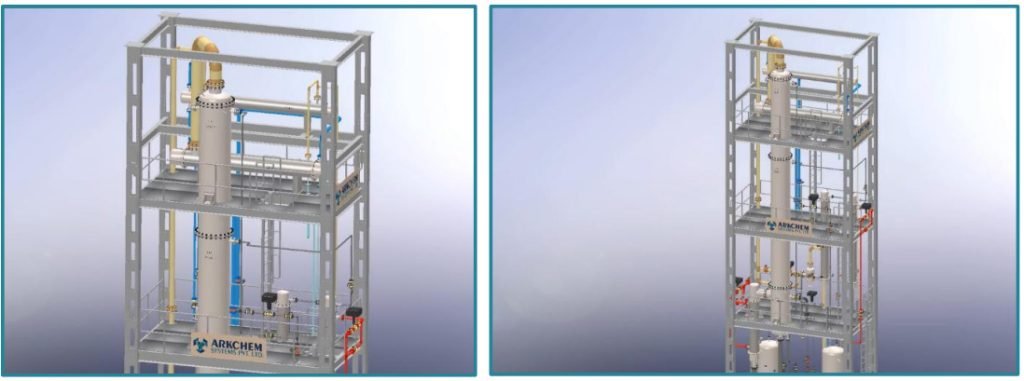
Batch and Continuous Distillation are two distinct methods of separating liquids based on their boiling points. They are tailored for different industrial needs depending on the volume and scale of operation.
Batch Distillation
How It Works: A fixed amount (batch) of liquid is loaded into the distillation setup, processed entirely, and then replaced with a new batch.
• Features:
Operates step-by-step, making it suitable for small-scale operations or industries with varying requirements.
Offers flexibility to handle different mixtures in successive batches.
Applications:
Pharmaceutical industry for small-scale purification of active ingredients.
Food processing to extract essential oils and Flavors.
Chemical labs for precise separation of substances.
Advantages:
Ideal for products that require frequent changes in mixture or components.
Easier to control for small-scale processes.
Process Flow for Batch Distillation System
Feed Solution Inlet → (A fixed volume of liquid mixture is introduced into the distillation unit)
⇩
Heating Unit (Boiler/Reboiler) → (The liquid is heated to initiate evaporation)
⇩
Distillation Column → Fractionation Trays or Packing Material → (Enhances separation efficiency) Vapor Rises → (Components separate based on boiling point differences)
⇩
Condenser Unit → (Cools vapor into liquid form for collection)
⇩
Distillate Collection Tanks → (Purified components are collected in separate containers)
⇩
Bottoms Outlet → (Remaining concentrated liquid residue is removed)
Key Equipment Involved
Feed Tank & Pump (Controls the introduction of each batch into the system)
⇩
Heating Unit (Boiler/Reboiler) (Provides heat for vaporization)
⇩
Distillation Column with Fractionation Trays/Packing (Optimizes separation process)
⇩
Condenser System (Cools vapor back into liquid for collection)
⇩
Vacuum System (Optional: Lowers boiling point for more efficient operation)
⇩
Final Collection Tanks (Stores purified fractions and residual components)