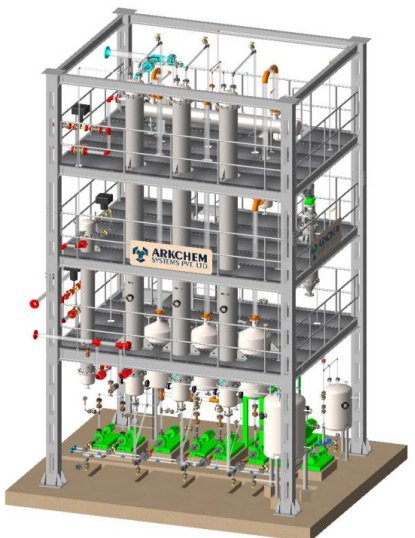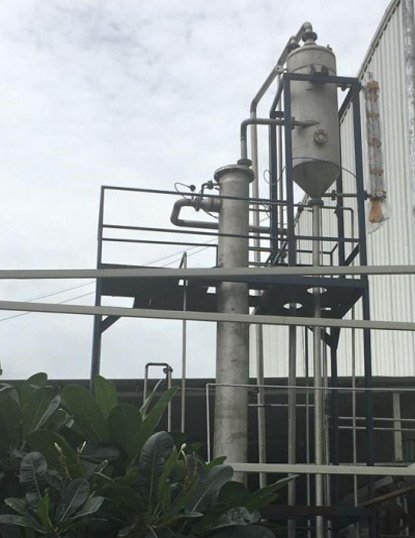
Forced Circulation Evaporator (FCE)
A Forced Circulation Evaporator (FCE) is a specialized system designed to concentrate solutions or suspensions by evaporating the solvent. It uses a pump to circulate the liquid at high velocity through heat exchanger tubes, ensuring efficient heat transfer and preventing scaling or fouling. This system is ideal for handling viscous, heat-sensitive, or crystallizing materials.
How It Works
- Liquid Circulation: The liquid feed is pumped at high velocity through the heat exchanger tubes to prevent boiling on the tube surfaces.
- Heat Transfer: Steam or hot water heats the liquid indirectly, causing the solvent to evaporate.
- Vapor-Liquid Separation: The heated liquid enters a vapor separator, where the vapor is separated from the concentrated liquid.
- Concentration: The remaining liquid becomes more concentrated as the solvent evaporates.
- Discharge: The concentrated liquid is collected, while the vapor is removed for further processing or condensation.
Distinct Features of Forced Circulation Evaporators
- High Heat Transfer Efficiency: The forced circulation ensures rapid and uniform heat transfer.
- Handles Viscous Materials: Suitable for thick or sticky solutions.
- Prevents Scaling: High velocity prevents deposits on tube surfaces.
- Continuous Operation: Ideal for large-scale industrial applications.
- Customizable Design: Adaptable to specific industry needs.
Unique Operating Conditions
- Vacuum Operation: Can operate under vacuum for low-temperature evaporation, making it suitable for heat-sensitive materials.
- Multi-Effect Setup: Can be integrated into multi-effect systems, where vapor from one stage is reused in subsequent stages, improving energy efficiency.
Common Challenges Addressed by FCEs
- Fouling: High velocity minimizes fouling, ensuring longer operational cycles without frequent cleaning.
- Viscous Liquids: Performs well with thick or sticky liquids, maintaining efficiency in demanding applications.
- Crystallization: Effectively handles crystallizing solutions, ensuring consistent operation.
Applications
- Pharmaceuticals: Concentrating thermolabile substances like insulin and liver extracts.
- Food Industry: Processing syrups, tomato paste, and fruit pulp.
- Chemical Industry: Concentrating chemical solutions and handling corrosive liquids.
- Effluent Treatment: Treating wastewater and recovering valuable components.
Key Benefits
- High Efficiency: Optimized heat transfer and reduced energy usage.
- Gentle Processing: Preserves the quality of heat-sensitive materials.
- Versatility: Suitable for a wide range of liquids, including viscous and crystallizing solutions.
- Compact Design: Saves space while maintaining high throughput.
Material of Construction
- Options: SS 304, SS 316, MS, or as per client requirements.
Forced Circulation Evaporators are highly efficient and versatile systems, making them a preferred choice for industries requiring reliable and consistent evaporation processes.
Process Flow for Forced Circulation Evaporator (FCE) System
Feed Solution Inlet → (Liquid enters the system for processing)
⇩
Feed Pump → (Pumps liquid at high velocity through heat exchanger tubes to
prevent boiling on surfaces)
⇩
Heat Exchanger → (Steam or hot water indirectly heats the liquid, initiating
evaporation)
⇩
Vapor Separator → (Separates vapor from the concentrated liquid)
⇩
Concentration Stage → (Remaining liquid becomes more concentrated as solvent
evaporates)
⇩
Final Collection Tank → (Stores concentrated liquid for further processing)
⇩
Vapor Outlet → (Separated vapor is removed for condensation or further
processing)
Key Equipment Involved
High-Velocity Feed Pump (Prevents surface boiling and
enhances circulation)
⇩
Heat Exchanger (Steam or hot water heats the liquid for controlled evaporation)
⇩
Forced Circulation Tubes (Ensures uniform heat distribution and prevents
fouling)
⇩
Vapor Separator (Removes entrained liquid particles from vapor stream)
⇩
Vacuum System (Optional: Lowers boiling point for efficient operation)
⇩
Condensation Unit (Recovers and cools vapor for reuse)
⇩
Final Collection Tank (Stores concentrated product for further use)