
Rising Film Evaporator
A Rising Film Evaporator (RFE) is a vertical heat exchanger designed to concentrate solutions by evaporating the solvent. It is particularly effective for low-viscosity liquids and is widely used in industries like food, pharmaceuticals, and chemicals.
How It Works
- Liquid Feed Entry: The liquid enters the evaporator from the bottom of the tubes.
- Heat Transfer: Steam or another heating medium heats the liquid as it flows upward inside the tubes.
- Film Formation: The heat causes the liquid to boil, forming vapor. The vapor pushes the liquid upward, creating a thin film along the tube walls.
- Co-Current Flow: The vapor and liquid flow together upward, enhancing turbulence and improving heat transfer efficiency.
- Vapor-Liquid Separation: At the top, the vapor and remaining liquid are separated in a vapor-liquid separator.
Features of Rising Film Evaporators
- Continuous Process: Operates continuously, making it ideal for large-scale applications.
- High Heat Transfer Efficiency: The co-current flow and turbulence improve heat transfer rates.
- Low Residence Time: The liquid spends minimal time in the heated tubes, reducing the risk of thermal degradation.
- Scalability: Can be scaled for small or large production needs.
- Adaptability: Handles low-viscosity liquids and is suitable for heat-sensitive materials.
Unique Operating Conditions
- Vacuum Operation: Can operate under vacuum for low-temperature evaporation, protecting heat-sensitive substances.
- Multi-Effect Setup: Can be integrated into multi-effect systems for improved energy efficiency.
Common Challenges Addressed by RFEs
- Thermal Sensitivity: The short residence time minimizes heat exposure, preserving product quality.
- Foaming Liquids: Effectively handles foaming liquids by separating vapor and liquid efficiently.
- Energy Efficiency: Reduces energy consumption through optimized heat transfer.
Applications
- Food and Beverage: Concentrating juices, dairy products, and sweeteners.
- Pharmaceuticals: Solvent recovery and concentration of active ingredients.
- Chemical Industry: Evaporation of low-viscosity or heat-sensitive fluids.
- Effluent Treatment: Recovery of water and valuable components.
Key Benefits
- High Efficiency: Optimized heat transfer and reduced energy usage.
- Gentle Processing: Preserves the quality of heat-sensitive materials.
- Versatility: Suitable for a wide range of low-viscosity liquids.
- Compact Design: Saves space while maintaining high throughput.
Material of Construction
- Options: SS 304, SS 316, MS, or as per client requirements.
Rising Film Evaporators are highly efficient and versatile systems, making them a preferred choice for
industries requiring reliable and consistent evaporation processes.
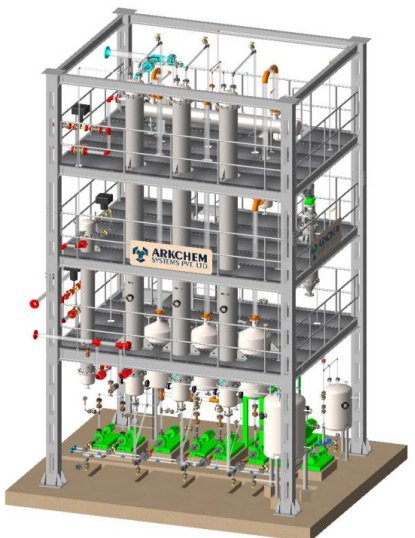
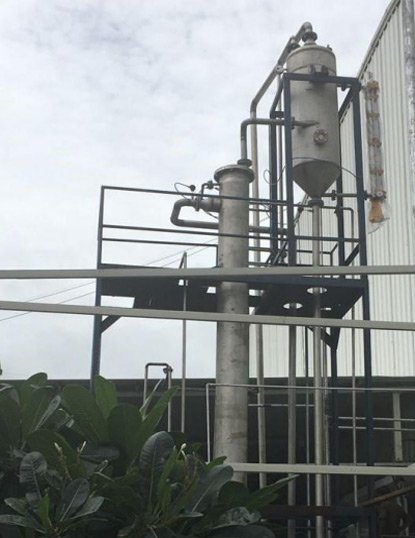
Process Flow for Rising Film Evaporator (RFE) System
Feed Solution Inlet → (Liquid enters the evaporator from the
bottom of the tubes)
⇩
Heat Transfer Section → (Steam or another heating medium indirectly heats the
liquid as it flows upward)
⇩
Film Formation → (Heat causes boiling, generating vapor that pushes the liquid
upward)
⇩
Co-Current Flow → (Vapor and liquid flow together upward, enhancing
turbulence and heat transfer)
⇩
Vapor-Liquid Separator → (At the top, vapor and remaining liquid are efficiently
separated)
⇩
Final Collection Tank → (Stores concentrated liquid for further processing)
⇩
Vapor Outlet → (Separated vapor is removed for condensation or reuse)
Key Equipment Involved
Feed Pump (Ensures controlled liquid entry into the evaporator)
⇩
Heated Tube Bundle (Provides indirect heat transfer for controlled evaporation)
⇩
Rising Film Tubes (Allow liquid to move upward while forming a thin film)
⇩
Vapor-Liquid Separator (Separates entrained liquid droplets from vapor stream)
⇩
Vacuum System (Optional: Reduces boiling point for better energy efficiency)
⇩
Condensation Unit (Recovers vapor for reuse or disposal)
⇩
Final Collection Tank (Stores concentrated solution for further use)