
Falling Film Evaporator
A Falling Film Evaporator (FFE) is a vertical heat exchanger equipped with a shell, tube bundle, and a vapor-liquid separator located at its base. The liquid to be processed is introduced at the top of the tubes and evenly distributed to form a thin film that flows along the inner surfaces of the tubes. As the thin film moves downward, heat is applied to the tubes, causing the liquid to evaporate. The resulting vapours travel alongside the liquid in a co-current flow. This vapor movement generates turbulence, which enhances heat transfer efficiency. At the bottom, the vapor and the remaining liquid are effectively separated in the vapor-liquid separator
How It Works
- Film Formation: Liquid feed enters at the top of the tube bundle and is evenly distributed to form a thin film over the inner surface of the heated tubes.
- Heat Transfer: Heat is applied externally to the tubes, causing the liquid film to evaporate as it flows downward due to gravity.
- Co-Current Flow: Vapours generated during evaporation travel alongside the liquid in a co current direction, enhancing turbulence and improving heat transfer efficiency.
- Vapor-Liquid Separation: At the bottom, the vapor and remaining liquid are separated in the vapor-liquid separator, ensuring efficient phase separation.
Distinct Features of Falling Film Evaporators:
- Continuous Process: FFEs operate continuously, making them ideal for large-scale industrial applications where uninterrupted processing is necessary.
- Energy Efficiency: FFEs use co-current vapor flow, reducing the need for excessive energy input during the evaporation process.
- Minimal Retention Time: The liquid spends minimal time in the heated tubes, reducing the risk of thermal degradation, especially for heat-sensitive substances.
- Scalability: FFEs can be scaled for different capacities, accommodating both small and large production requirements with consistent efficiency.
- Adaptability to Fluids: These systems handle various types of liquids, from low-viscosity solutions to high-viscosity or even fouling-prone materials.
Unique Operating Conditions
- FFEs can operate under vacuum for low-temperature evaporation, making them highly suitable for temperature-sensitive materials.
- They are particularly effective in multi-effect setups, where vapor generated in one stage is reused in subsequent stages for heating, improving overall energy efficienc
Common Challenges Addressed by FFEs
- Fouling: The thin film design minimizes fouling, ensuring longer operational cycles without frequent cleaning.
- Viscous Liquids: FFEs perform well even with thick or sticky liquids, maintaining efficiency in demanding applications.
- Quality Consistency: FFEs offer consistent evaporation rates, ensuring uniform product quality.
Operating Principles:
- Thin Film Formation: Liquid enters at the top and is evenly distributed as a thin film along the inner surface of heated tubes.
- Heat Transfer: The liquid film is heated, causing evaporation as the liquid moves downward due to gravity.
- Co-Current Flow: Vapours generated during heating flow alongside the liquid in the same direction, creating turbulence and improving heat transfer efficiency.
- Vapor-Liquid Separation: At the bottom, the vapor and residual liquid are separated in a vapor-liquid separator, ensuring efficient phase separation.
Applications
- Food and Beverage: Concentrating juices, dairy, and sweeteners.
- Pharmaceuticals: Solvent recovery and concentration of active ingredients.
- Chemical Industry: Evaporation of heat-sensitive or viscous fluids.
- Effluent Treatment: Recovery of water and valuable components.
Key Benefits
- High Efficiency: Optimized heat transfer and reduced energy usage.
- Gentle Processing: Preserves quality of heat-sensitive materials.
- Versatility: Suitable for low- to high-viscosity liquids.
- Compact Design: Saves space while maintaining high throughput.
Material of Construction: SS 304 / SS 316 / MS / As per client needs
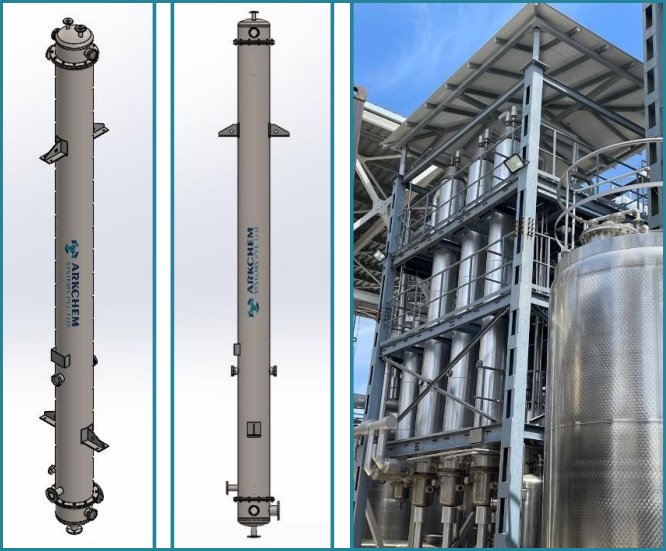
Process Flow for Falling Film Evaporator (FFE) System
Feed Solution Inlet → (Liquid enters the system at the top of the
tube bundle)
⇩
Liquid Distributor → (Ensures uniform film formation over the inner tube
surface)
⇩
Heat Transfer Section → (Steam or hot water applies heat externally to the tubes)
⇩
Co-Current Evaporation → (Liquid evaporates while vapors flow alongside in
the same direction)
⇩
Vapor-Liquid Separator → (Separates vapor from the concentrated liquid at the
bottom)
⇩
Final Collection Tank → (Stores concentrated liquid for further processing)
⇩
Vapor Outlet → (Separated vapor is removed for condensation or reuse)
Key Equipment Involved
Feed Pump (Ensures continuous liquid entry at the top of the
system)
⇩
Liquid Distributor (Maintains uniform thin film formation across heated tube
surfaces)
⇩
Heat Exchanger (Provides indirect heat transfer to the falling liquid film)
⇩
Falling Film Tubes (Allow liquid to flow downward, enabling efficient
evaporation)
⇩
Vapor-Liquid Separator (Separates entrained liquid from vapor efficiently)
⇩
Vacuum System (Optional: Lowers boiling point for better energy efficiency)
⇩
Condensation Unit (Recovers vapor and converts it back into liquid)
⇩
Final Collection Tank (Stores concentrated liquid for further use)