
Horizontal Thin Film Evaporator
The Horizontal Thin Film Evaporator (HTFE) is an advanced system designed to evaporate solutions efficiently by forming a thin, agitated film. It incorporates a precision-engineered jacketed shell and a centrally located high-speed rotor equipped with closely fitting blades. This setup ensures uniform
heat transfer and optimized evaporation performance.
How It Works:
- Feed Input: The feed material, whether in the form of solution, slurry, or wet cake, is
introduced into the evaporator. - Thin Film Formation: The rotor spreads the feed into a thin film along the inner surface of
the shell, enhancing heat exposure. - Intense Agitation: The rotor blades create high-speed agitation, ensuring uniform heat
transfer and preventing fouling. - Evaporation Process: As the film is heated, it transitions through phases, transforming from
slurry to paste, and finally to vapor. - Vapor-Liquid Separation: The remaining liquid and vapor are separated efficiently, ensuring
the desired outcome for further use or processing.
Applications:
- Pharmaceuticals: Evaporation of solvents and concentration of active ingredients.
- Food Processing: Production of concentrates from liquid food products.
- Chemical Industry: Evaporation of chemical solutions and heat-sensitive compounds.
- Environmental Engineering: Efficient treatment of industrial effluents.
Key Benefits:
- High Efficiency: Uniform thin film enables rapid heat transfer and evaporation.
- Gentle Process: Suitable for heat-sensitive and viscous materials.
- Versatility: Handles a wide variety of feed forms and liquid compositions.
- Compact Design: Space-saving construction with high throughput.
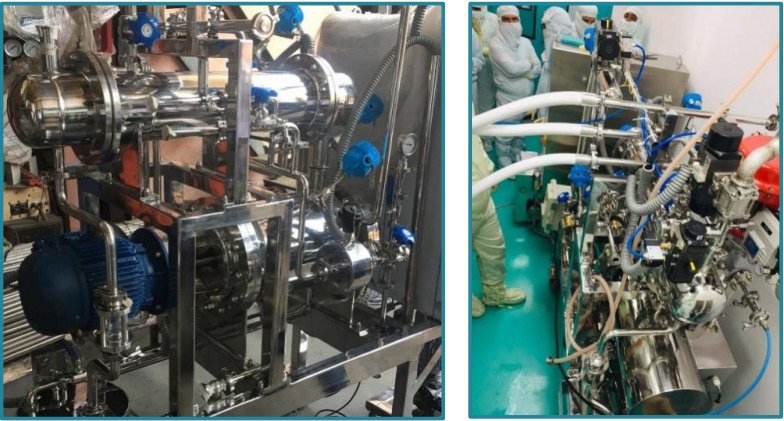
Process Flow for Horizontal Thin Film Evaporator (HTFE) System
Feed Input → (Solution, slurry, or wet cake is introduced into the evaporator)
⇩
Rotor Mechanism → (Spreads the feed into a thin film along the inner shell
surface)
⇩
Intense Agitation → (High-speed rotor blades ensure uniform heat transfer and
prevent fouling)
⇩
Evaporation Process → (Heat gradually transforms the feed from slurry to paste,
and then to vapor)
⇩
Vapor-Liquid Separator → (Efficiently separates the remaining liquid and vapor)
⇩
Final Collection Tank → (Stores the concentrated liquid for further processing)
⇩
Vapor Outlet → (Separated vapor is removed for condensation or reuse)
Key Equipment Involved
Feed Pump (Ensures controlled liquid entry)
⇩
Horizontal Thin Film Evaporator (Core unit for efficient evaporation)
⇩
High-Speed Rotor (Agitates and spreads feed into a uniform thin film)
⇩
Jacketed Shell (Provides optimal heat transfer for evaporation)
⇩
Vapor Separator (Removes entrained liquid droplets from vapor)
⇩
Vacuum System (Optional: Lowers boiling point to optimize energy efficiency)
⇩
Condensation Unit (Recovers vapor for reuse or disposal)
⇩
Final Collection Tank (Stores concentrated product for further use)