
Extraction Distillation
Extractive distillation is a specialized process used to separate liquid mixtures with components that have very close boiling points, making conventional methods like simple or fractional distillation less effective. It achieves this by introducing a solvent (extracting agent) that changes the relative volatility of the components, allowing for easier separation.
How It Works:
- Adding Solvent: A specially chosen solvent is mixed with the liquid to be separated. The solvent alters the boiling behaviour of the components.
- Heating: The mixture is heated, and the component with the adjusted boiling point starts to vaporize.
- Separation: The vapor is collected, condensed, and separated from the solvent.
- Solvent Recovery: The solvent is recycled for reuse, making the process efficient and cost effective.
Applications:
- Petrochemical Industry: Separation of hydrocarbons with close boiling points, such as in refining processes.
- Chemical Production: Separation of specialty chemicals or solvents.
- Pharmaceuticals: Purification of active ingredients and separating complex mixtures.
Benefits:
- Effective for Difficult Mixtures: Provides separation when boiling points are very close.
- Energy-Efficient: Requires less energy compared to other methods for such mixtures.
- Versatile: Can handle various combinations of solvents and components.
- Cost-Effective: Solvent recovery reduces operational costs.
Material of Construction: SS 304 / SS 316 / MS / As per client needs
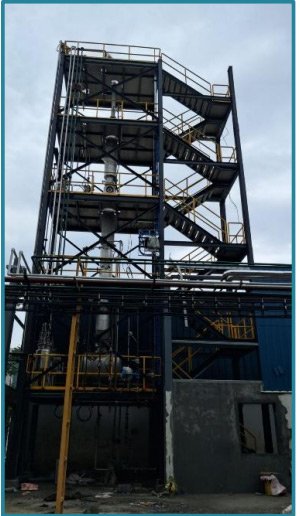
Process Flow for Extractive Distillation System
Feed Solution Inlet → (Liquid mixture enters the system for processing)
⇩
Solvent Addition Unit → (A specially chosen solvent is mixed with the liquid to
alter component boiling behavior)
⇩
Heating Section (Boiler/Reboiler) → (Mixture is heated, initiating selective
vaporization)
⇩
Distillation Column →
Fractionation Trays / Packing Material → (Ensures effective separation based on
adjusted boiling points)
Co-Current Flow → (Vapor rises, while liquid moves downward with solvent
interaction)
⇩
Condenser Unit → (Cools vapor to convert it back into liquid)
⇩
Solvent Recovery System → (Extracted solvent is purified and recycled for reuse)
⇩
Distillate Collection Tanks → (Separated components are stored for further processing)
⇩
Bottoms Outlet → (Residue removed for disposal or additional treatment)
Key Equipment Involved
Feed Pump (Controls liquid entry into the system)
⇩
Solvent Injection System (Ensures precise solvent addition for enhanced separation)
⇩
Heating Unit (Boiler/Reboiler) (Provides heat for controlled vaporization)
⇩
Distillation Column with Packing or Trays (Optimizes fractionation and
component separation)
⇩
Condenser Unit (Recovers vapor by converting it into liquid)
⇩
Vacuum System (Optional: Reduces boiling point for better efficiency)
⇩
Solvent Recovery System (Purifies and reuses solvent for cost-effective operation)
⇩
Final Collection Tanks (Stores purified distillate and residue)