
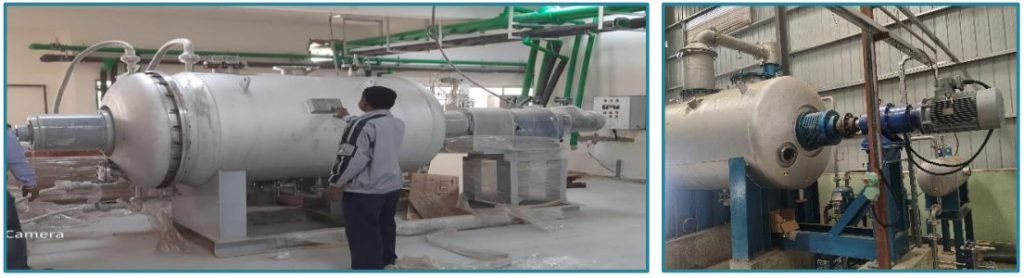
Rotary Vacuum Paddle Dryer (RVPD)
A Rotary Vacuum Paddle Dryer (RVPD) is a specialized drying system used to remove moisture from wet materials like slurries, pastes, or powders. It operates under vacuum conditions, which allows for drying at lower temperatures, making it ideal for heat-sensitive materials. The system uses a rotating shaft with paddles to mix and agitate the material, ensuring uniform drying.
How It Works:
- Material Feeding: The wet material is loaded into the dryer.
- Vacuum Creation: A vacuum is applied to lower the boiling point of moisture, enabling
drying at lower temperatures. - Heating: The jacketed vessel or limpet coil provides consistent heat to the material.
- Agitation: The paddles on the rotating shaft continuously stir the material, preventing
clumping and ensuring even heat distribution. - Moisture Removal: The moisture evaporates and is removed through a vacuum system.
- Discharge: The dried material is discharged through a valve for further use.
Key Features and Benefits:
- Low-Temperature Drying: Ideal for heat-sensitive materials, as drying occurs under vacuum.
- Uniform Drying: Continuous agitation ensures even drying and prevents sticking.
- Efficient Solvent Recovery: Solvents can be recovered during the drying process.
- Closed System: Safe for handling toxic or hazardous materials.
- Energy Efficient: Vacuum drying reduces energy consumption compared to conventional methods.
Applications:
- Pharmaceuticals: Drying active ingredients and intermediates.
- Chemicals: Processing specialty chemicals, pigments, and dyes.
- Food Industry: Drying food additives and ingredients.
- Waste Management: Drying sludge and other waste materials.
Material of Construction: SS 304 / SS 316 / MS / As per client needs
Process Flow for Rotary Vacuum Paddle Dryer (RVPD) System
Material Feeding → (Wet material is loaded into the dryer through a controlled
feed system)
⇩
Vacuum Creation → (Vacuum lowers the boiling point of moisture, enabling
drying at lower temperatures)
⇩
Heating Mechanism → (Jacketed vessel or limpet coil provides consistent heat
transfer for evaporation)
⇩
Agitation Process → (Rotating paddles stir material continuously, preventing
clumping and ensuring uniform heat distribution)
⇩
Moisture Removal → (Evaporated moisture is efficiently removed via the vacuum
system)
⇩
Discharge System → (Dried material is discharged through a valve for collection
or further processing)
Key Equipment Involved
Feed Hopper / Screw Conveyor (Controls material entry into the drying chamber)
⇩
Jacketed Vessel / Limpet Coil (Provides indirect heating for optimized moisture
evaporation)
⇩
Rotating Paddle Agitator (Ensures uniform mixing and prevents material buildup)
⇩
Vacuum System (Enhances drying efficiency and lowers moisture boiling point)
⇩
Condensation Unit (Recovers and removes evaporated moisture)
⇩
Final Collection Bins (Stores dried product for packaging or further use)