
Solvent Extraction Plants
Solvent Extraction Plants are systems designed to extract valuable components, such as oils, fats, or active compounds, from raw materials using solvents. These plants are widely used in industries like food, pharmaceuticals, and chemicals for efficient and large-scale extraction.
How Do They Work?
- Material Preparation: The raw material, such as seeds or herbs, is cleaned and prepared for extraction.
- Solvent Application: A suitable solvent is added to dissolve the desired components from the material.
- Separation: The mixture is processed to separate the solvent containing the extracted compound from the leftover material.
- Solvent Recovery: The solvent is removed and recovered for reuse, leaving behind the extracted product.
- Purification: The extracted product is purified to meet quality standards.
Features
- High Efficiency: Extracts maximum yield from raw materials.
- Customizable Design: Adaptable to different materials and processes.
- Solvent Recovery: Reduces waste and operational costs.
- Closed System: Ensures safety and prevents contamination.
- Scalable: Suitable for small-scale or large-scale production.
Benefits
- Cost-Effective: Optimized processes save time and resources.
- Eco-Friendly: Promotes solvent recycling and minimizes waste.
- Versatile: Handles a wide range of raw materials.
- Safe Operation: Closed systems ensure safe handling of solvents.
Applications
- Food Industry: Extracting oils from seeds, such as soybean or sunflower.
- Pharmaceuticals: Isolating active ingredients for medicines.
- Cosmetics: Extracting natural oils for skincare products.
- Chemicals: Processing dyes, pigments, and specialty chemicals.
Why Choose Our Solvent Extraction Plants?
- Advanced Technology: Ensures efficient and reliable extraction.
- Custom Solutions: Tailored to meet your specific needs.
- Durable and Reliable: Built with high-quality materials for long-term use.
- Eco-Friendly Design: Reduces waste and promotes sustainability.
- Comprehensive Support: Includes training, maintenance, and after-sales services.
Steps
Raw Material Preparation → Solvent Addition → Extraction Process → Solid & Liquid Separation → Solvent Recovery → Purification → Product Collection → Solvent Recycling
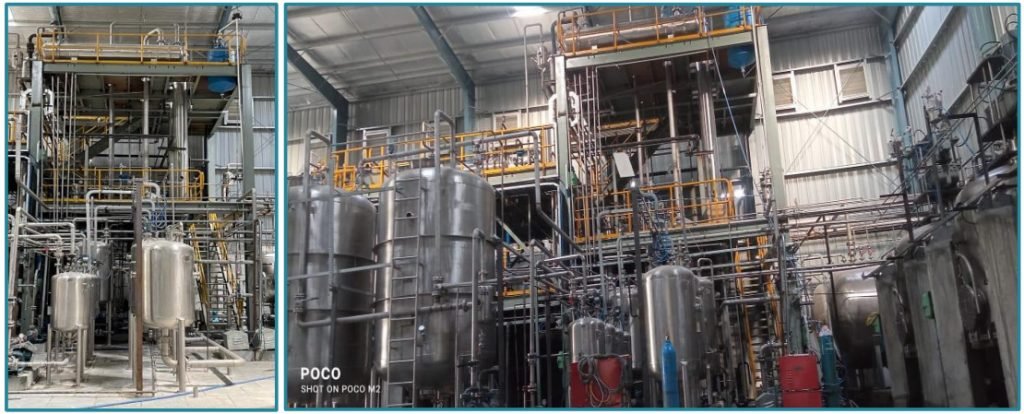
Process Flow for Solvent Extraction Plant
Material Preparation → (Raw material, such as seeds or herbs, is cleaned, dried, and processed for extraction)
⇩
Solvent Application → (A suitable solvent is added to dissolve the desired components from the material)
⇩
Mixing & Soaking → (Material is thoroughly mixed or soaked in the solvent for maximum component dissolution)
⇩
Separation Stage → (Solvent-containing extract is separated from the solid residue using filtration or decantation)
⇩
Solvent Recovery → (Solvent is removed through evaporation, distillation, or membrane separation and recycled for reuse)
⇩
Purification Stage → (Extracted product undergoes refinement to meet quality standards)
⇩
Final Collection & Packaging → (Purified extract is collected for further
processing or commercial use)
Key Equipment Involved
Material Pre-Treatment Unit (Crushers, grinders, or homogenizers to prepare raw material)
⇩
Extraction Vessel / Reactor (Holds material and solvent for controlled extraction)
⇩
Agitators / Mixers (Ensures uniform solvent contact for better yield)
⇩
Filtration & Separation Units (Decanters, centrifuges, or membrane filters for effective separation)
⇩
Solvent Recovery System (Evaporators, distillation columns, or membrane units for solvent purification)
⇩
Drying System (Vacuum dryers or spray dryers for moisture removal from final extract)
⇩
Final Collection Tanks & Packaging Line (Safely stores purified extract for packaging or distribution)